Startup cost guide
How much does it cost to start a spray foam business?
Most of the money goes into the rig. Here is what trailer rigs and starter packages list for, what homeowners pay per board foot, and how to test a job's math before you buy.
Calculator
Spray foam business payback calculator
Key takeaways
- New spray foam trailer rigs run about $38,000-$60,000 at entry level and $60,000-$90,000 for midrange, and box-truck rigs reach $130,000-$200,000 (ThePricer, 2026).
- Budget past the rig. ThePricer's sample launch plan adds $24,500 for PPE, parts, first chemicals, insurance, training and a cash reserve to a $64,995 rig.
- A set of open-cell foam yields about 13,000-15,000 board feet and closed-cell 4,000-5,000, so closed-cell uses roughly three times as many sets per board foot.
- Customer prices vary widely by source: about $0.44-$2.50 per board foot for open-cell and $1.25-$4.60 for closed-cell across This Old House and HomeGnome.
- ArmorThane sells Starter, Mobile Coatings Unit and Enterprise packages but publishes no prices, so ask for an itemized quote to compare.
What it costs to start a spray foam business
The rig is the big number. ThePricer's October 2026 guide puts a new entry-level trailer rig at $38,000 to $60,000 and a midrange production trailer at $60,000 to $90,000. A turnkey box truck can reach $200,000.
| Tier | Price range | What you get |
|---|---|---|
| Entry trailer rig | $38,000-$60,000 | Trailer, spray machine, hoses, transfer gear |
| Midrange production trailer | $60,000-$90,000 | Higher-output machine; ThePricer's example adds a 30 kW generator |
| High-output trailer | $90,000-$130,000+ | Higher-output equipment |
| Turnkey box truck | $130,000-$200,000 | Self-contained truck |
| Used professional rig | About $60,000-$90,000 | Complete system; age and setup set the price |
A complete system includes a proportioner, heated hose, gun, transfer pumps, compressor, air dryer, power, chemical storage and safety gear. The proportioner alone is a big slice: ThePricer prices a Graco Reactor 3 E-20 Standard at about $28,120 and an E-30 Standard at about $37,000.
Money you need beyond the rig
ThePricer's sample budget for a $64,995 rig comes to about $89,495 before the first job. The extra $24,500:
- PPE and respiratory equipment: $2,500
- Spare parts: $2,000
- First chemicals: $5,000
- Insurance, registration and setup: $3,000
- Training and travel: $2,000
- Operating reserve: $10,000
Treat that as a checklist, not a quote. Financing adds more: ThePricer's example of $70,000 over five years at 9% costs about $1,453 a month and roughly $17,200 in interest.
Spray foam rig prices from named vendors
Listed prices for starter packages and complete rigs, checked on vendor sites in October 2026, run from $37,995 to just under $100,000. Most are starting prices.
| Vendor | Package | Key equipment | Listed price |
|---|---|---|---|
| SprayEZ | SprayEZ 3000 starter rig | 7x16 trailer | From $37,995 |
| SprayEZ | Graco A-25 starter rig | Pneumatic Graco Reactor A-25 | From $45,540 |
| SprayEZ | PMC PH2 starter rig | Hydraulic PH2, 7x16 trailer | $47,995 (limited time) |
| SprayEZ | Graco R3 E-20 starter rig | Reactor 3 E-20, 7x16 trailer | From $60,843 |
| SprayEZ | SprayEZ 4500 rig | 30 kW generator | From $64,995 |
| Spray Foam Systems | ProPak 200G | Reactor 3 E-20 Elite, 12-ft trailer, 22 kW generator, 200 ft heated hose, fresh-air system | $75,000 (cut from $82,000) |
| Intech Equipment | 2025 Graco R2 E30 trailer | 20-ft trailer, 35 kW generator, 200 ft hose | $97,451 (sold; dealer will build a match) |
| ArmorThane | Mobile Coatings Unit | PMC PHX-40 or Premier X, 20-26 ft trailers | Not published |
Questions to ask any rig vendor
Two rigs at the same price may not be the same rig. Get these answers in writing:
ArmorThane's spray foam and coatings packages
This site is sponsored by ArmorThane USA of Springfield, Missouri, which sells applicator startup packages, including spray foam rigs.
Its spray foam business page lists three tiers and publishes no price for any of them.
- Starter: basic plural-component equipment, a product starter package, on-site training and dealer portal access. ArmorThane pitches it at bedliners and small jobs.
- Mobile Coatings Unit (labeled "Most Popular"): a high-pressure system, protected territory, on-site training and a marketing package, as a fixed shop or mobile unit.
- Enterprise: high-volume equipment, a custom Mobile Coatings Unit, team training, the largest territory and a dedicated account manager, aimed at commercial and industrial work.
Mobile Coatings Unit trailer builds
ArmorThane's MCU builder shows three setups, also unpriced:
- 20-ft rig: PMC PHX-40, 45 kW diesel generator, 23 CFM of air, 100 ft of heated hose. ArmorThane builds this one most often.
- 24-ft rig: PHX-40 with a 45 kW diesel generator.
- 26-ft gooseneck: PMC Premier X, 40 kW Perkins generator, 400 ft of heated hose.
ArmorThane charges no franchise fees, dealer fees or royalties, and delivers equipment and on-site training within 30 days. The $25,000 starting price on its site is for bedliner systems, not these foam packages. See franchise vs independent for how the models differ.
Ask for an itemized quote
Ask for a line-item quote naming the proportioner, generator, compressor, hose length and starter material, then set it next to the listed rigs above.
What customers pay for spray foam insulation
Price sources disagree widely, so use them to sanity-check local quotes, not to set prices. A board foot is one square foot of foam one inch thick, so a per-square-foot price at 1 inch equals a per-board-foot price.
| Source | Open-cell | Closed-cell | What it covers |
|---|---|---|---|
| This Old House (Apr 2026) | $0.44-$1.50 | $1.25-$2.90 | Per sq ft at 1 inch thick |
| HomeGnome (2025) | $0.75-$2.50 | $1.60-$4.60 | Per board foot, installed |
| Fixr (Jan 2025) | $0.44-$0.65 | $1.00-$1.50 | Per board foot, material only |
Fixr's national average is $20,000 a project, most between $10,000 and $30,000. That figure is for a 2,000 sq ft existing home sprayed 6 inches deep with mixed foam. Single areas cost far less:
- Attic: $2,500-$12,000 in an existing home (Fixr); $1,500-$7,400, average $4,450 (This Old House)
- Crawl space: $1,000-$5,900 (Fixr)
- Basement: average $3,550 (This Old House)
- Garage: average $4,500 (This Old House)
Material yield and a worked attic example
Your material cost per board foot is your set price divided by the set's yield. Spray Foam Systems puts open-cell at 13,000-15,000 board feet per set and closed-cell at 4,000-5,000, and suggests adding about 10% for waste.
No current per-set price was available for this guide, so the math scales to your supplier's quote. Derived: for every $1,000 a set costs, open-cell works out to about $0.07-$0.08 per board foot and closed-cell to $0.20-$0.25.
Get the set price in writing
Ask for the current price per set and the rated yield from the product's technical data sheet. Both change.
Example: a 1,000 sq ft attic roof deck
This is an example, not a quote. It assumes 1,000 sq ft of roof deck, open-cell at 6 inches or closed-cell at 3 inches, and 10% waste. The depths keep the math simple; they are not a code recommendation.
| Line | Open-cell, 6 in | Closed-cell, 3 in |
|---|---|---|
| Board feet billed | 6,000 | 3,000 |
| Board feet with 10% waste | 6,600 | 3,300 |
| Sets used | 0.44-0.51 | 0.66-0.83 |
| Material cost per $1,000 of set price | $440-$508 | $660-$825 |
| Price at This Old House rates | $2,640-$9,000 | $3,750-$8,700 |
| Price at HomeGnome rates | $4,500-$15,000 | $4,800-$13,800 |
The same attic bills anywhere from $2,640 to $15,000 depending on whose rates you use. Open-cell material stays near half a set either way. Local prices decide whether the job pays.
Fixed costs come out of that gap. ThePricer's sample loan payment of about $1,453 a month equals roughly a third of one $4,450 attic job (derived).
Run your own numbers in the calculator
These are not your margins
The ranges come from homeowner cost sites. They leave out your labor, fuel, insurance and callbacks.
Open-cell vs closed-cell from the business side
Closed-cell sells for more per board foot but a set covers about a third as much. A 2009 Department of Energy Building America guide lists aged R-values of about R-3.6 per inch for open-cell and R-6.1 for closed-cell.
Open-cell
- 13,000-15,000 board feet per set
- $0.44-$1.50 (This Old House) or $0.75-$2.50 (HomeGnome) per board foot
- Not a vapor retarder; DOE says it is unsuited to below-grade spaces
- Fewer sets to haul for the same board feet
Closed-cell
- 4,000-5,000 board feet per set
- $1.25-$2.90 (This Old House) or $1.60-$4.60 (HomeGnome) per board foot
- A vapor retarder at typical thickness; DOE lists it for foundations and basements
- More sets per job, so material spend climbs
Plan your supply around the work you expect. Attics and walls lean on open-cell yield. Basements and foundations mean more closed-cell sets per job.
Training, certification and safety
Licensing is set by states and local governments, so check your contractor rules first. For the trade, the Spray Polyurethane Foam Alliance (SPFA) runs the Professional Certification Program.
- 1
Take a health and safety course
The Center for the Polyurethanes Industry (CPI) runs online SPF training at spraypolyurethane.org. It launched free in 2011; by 2019 about 25,000 people had finished it.
- 2
Train on your own rig
Vendor training should be on the machine you will run. ArmorThane includes on-site training in all three tiers.
- 3
Certify at SPFA's Assistant level
It needs no spraying experience.
- 4
Move up as you log board feet
Installer takes 100,000 board feet. Master Installer takes 500,000 plus a field exam.
SPFA's Project Manager level requires managing at least 500,000 board feet of projects, and a separate roofing track is measured in square feet. You can start at the level your experience supports. Check sprayfoam.org for fees.
Safety basics
Unprotected people can be exposed through skin contact and by breathing vapors, aerosols and dust, the EPA says. Its guidance:
- Only applicators and helpers in proper PPE belong in the work area.
- Occupants and other trades stay out until the foam cures and the space is ventilated and cleaned.
- Ventilate as the manufacturer directs, including HVAC shutdown and vent sealing.
- Re-entry time comes from the manufacturer. EPA says some recommend 24 hours for professional two-component foam, and it varies by product.
- Read each product's label and safety data sheet.
Residential vs commercial spray foam work
Residential jobs are smaller and quicker to sell. This Old House's average attic, basement and garage jobs fall between $3,550 and $4,500, and you can start that work with a starter trailer rig.
Commercial work rewards output. ThePricer notes a Graco E-30 is rated around 30 lb per minute, while larger hydraulic machines can top 50 lb per minute. Its high-output trailer tier starts around $90,000.
SPF roofing has its own SPFA certification track, and ArmorThane points its Enterprise tier at commercial and industrial work. Commercial bids can also bring general contractors, insurance requirements and slower payment. One way to stage it: start residential, log board feet toward SPFA's Installer level, then bid commercial jobs.
Risks to weigh before you buy a rig
Most of the risk comes up front. You buy the rig before you know your local prices or close rate.
- Slow early volume. ThePricer's break-even example takes 40 jobs at $2,000 contribution each to repay $80,000, about 10 months at four jobs a month.
- Equipment debt. Used rigs sell for about $60,000-$90,000 (ThePricer). Know the resale value before you finance.
- Material prices. A bid built on last quarter's set price can lose money. Re-check before large bids.
- Bad foam. Off-ratio or poorly applied foam can mean tear-out and respray at your cost.
- Health and liability. Exposure risk falls on your crew and your customers. Follow the manufacturer's re-entry time every time.
If the rig price is the barrier, a polyurea bedliner business costs less to start. Rhino Linings says its packages start at $12,000 and ArmorThane's bedliner systems start at $25,000. See how to start a bedliner business and bedliner equipment costs.
Frequently asked questions
How much does it cost to start a spray foam insulation business?
The rig is most of it: $38,000-$60,000 for a new entry trailer rig and $60,000-$90,000 for midrange, per ThePricer. Its sample launch budget adds about $24,500 for PPE, parts, first chemicals, insurance, training and a reserve.
How much does a spray foam rig cost?
SprayEZ lists starter packages from $37,995 to $64,995. Complete rigs from other dealers list at $75,000 to $97,451, and box-truck rigs run $130,000-$200,000. Confirm what each price includes.
Is a used spray foam rig a good way to start?
It can save money, but ThePricer says used professional rigs sell for about $60,000-$90,000, which overlaps new midrange rigs. Have the proportioner, hoses and generator inspected and ask about parts support.
How many board feet does a set of spray foam cover?
Spray Foam Systems puts open-cell at about 13,000-15,000 board feet per set and closed-cell at 4,000-5,000, plus about 10% for waste. Check the data sheet for your exact product.
Do I need certification to spray foam?
The Spray Polyurethane Foam Alliance's Professional Certification Program runs from Assistant (no experience) to Master Installer (500,000 board feet plus a field exam). Contractor licensing is a separate state and local matter.
Is open-cell or closed-cell more profitable?
No published data answers that. Closed-cell sells for more per board foot, but a set covers about a third as many board feet. Run both through your own set prices.
Does ArmorThane publish spray foam package prices?
No. Its three tiers and MCU trailer builds are priced on request. ArmorThane says it charges no franchise fees, dealer fees or royalties. Ask for a line-item quote to compare.
How long does it take for a spray foam rig to pay for itself?
It depends on volume and what each job leaves after costs. ThePricer's example needs 40 jobs at $2,000 each to cover $80,000, about 10 months at four jobs a month. Try your numbers in the calculator at the top of this page.
Sources
- ThePricer: How much does a spray foam rig cost? (October 2026)
- SprayEZ: Spray foam starter rig packages (accessed October 2026)
- Spray Foam Systems: ProPak 200G rig, Graco Reactor 3 E-20 Elite on a 12-ft trailer (accessed October 2026)
- Intech Equipment: 2025 Graco R2 E30 Reactor spray foam trailer, 20 ft diesel (accessed October 2026)
- ArmorThane: Starting a spray foam business (accessed October 2026)
- ArmorThane: Mobile Coatings Unit builder (accessed October 2026)
- ArmorThane: Mobile spray rig (accessed October 2026)
- ArmorThane: Dealer info (accessed October 2026)
- ArmorThane: Become a bedliner applicator (accessed October 2026)
- Rhino Linings: Dealer FAQs (accessed October 2026)
- Fixr: Spray foam insulation cost (January 2025)
- HomeGnome: Spray foam insulation price (2025)
- This Old House: Spray foam insulation cost (April 2026)
- Spray Foam Systems: Calculating the amount of spray foam needed for a job (January 2026)
- U.S. Department of Energy, Building America: Which spray foam is right for you? (April 2009)
- Spray Polyurethane Foam Alliance: Individual certification programs (accessed October 2026)
- Roofing Magazine: SPFA's Professional Certification Program Q&A (July 2019)
- American Chemistry Council, CPI: High-pressure SPF insulation worker and homeowner health and safety information (March 2019)
- Spray Foam Magazine: CPI announces online spray foam safety training (January 2011)
- U.S. EPA: Vacate and safe re-entry time for spray polyurethane foam application (September 2020)
- U.S. EPA: Quick safety tips for spray polyurethane foam users (September 2020)
Prices are published figures from the sources above, checked in October 2026. Vendors change prices and package contents, so confirm current numbers in writing. Calculator results are examples, not promises of income.
Keep reading

Startup guide · Calculator
How to start a spray-on bedliner business
Equipment starts around $25,000, the shop costs a few thousand more, and a standard bed sells for roughly $450 to $800. Here is how the numbers…
Read the guide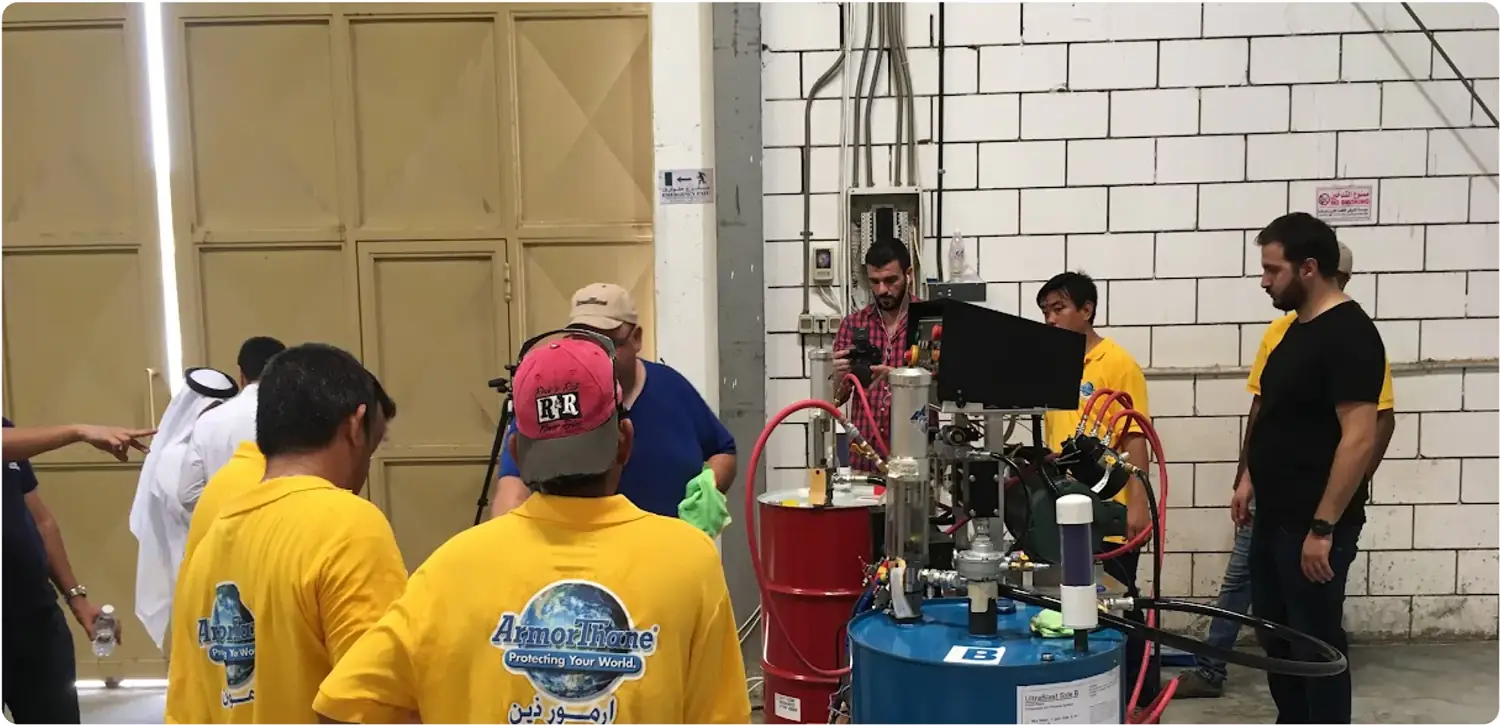
Equipment guide · Calculator
How much does spray-on bedliner equipment cost?
Published prices for low-pressure packages, high-pressure proportioners and full trailer rigs, plus the gear each one leaves out of the box.
Read the guide