Business guide
Running an RV roof coating business: what to charge per job
Spray-on RV roofs are priced by the foot and sell for thousands of dollars a job. This guide covers what owners pay, how much material a roof takes, and how to build a quote that covers both.
Calculator
RV roof coating payback calculator
Key takeaways
- ThePricer's 2024 data puts spray-on RV roofs at $130 to $200 a foot across four brands, with FlexArmor's median at $185.
- Real bills run from $5,250 for a 30-ft RV to $9,300 for a 41-ft coach, and the biggest ones include deck repair and solar panel work.
- At 100% solids, a 300 sq ft roof at 60-80 mils takes about 11-15 gallons before waste. Price material from that math, not from a coverage claim.
- ArmorThane puts a job at 1-2 days, so compare revenue per bay-day with your bedliner work, not revenue per job.
- Confirm with your supplier, in writing, which roof products your equipment can spray before you sell the first roof.
What RV owners pay for a spray-on roof
Spray-on RV roofs are sold by the linear foot, and ThePricer's 2024 data puts the going rate at $130 to $200 a foot across four brands. FlexArmor sits at the top with a median of $185. Florida winter promotions have dipped to $130, and some West Coast jobs top $210.
| Brand | Price per foot | Notes |
|---|---|---|
| FlexArmor | $170-$200 | Median $185. Florida promos as low as $130; West Coast sometimes above $210. |
| Rhino Eco-Coat | $155-$180 | |
| RV Armor | $150-$175 | |
| Spray-Lining | $130-$160 | |
| ArmorThane (its own site) | About $117-$233 | Published as $3,500-$7,000 for a 30-ft rig, divided by 30. |
Owner bills land inside those ranges. An RV owner on a Jayco forum reported paying RV Armor $5,250 for a 30-ft RV in October 2025, or $175 a foot. ThePricer also published three invoices.
| RV | What the bill covered | Total | Per foot |
|---|---|---|---|
| 30-ft RV (RV Armor) | Coating | $5,250 | $175 |
| 32-ft Class C, Alabama | Simple roof: two vent caps, one skylight, no wood repair | $6,000 | $188 |
| 37.6-ft fifth wheel, Kentucky | $6,950 coating, $600 plywood, $300 vent covers | $7,850 | $185 coating only |
| 41-ft coach, Oregon | Coating plus rotten decking and six solar panel removals | $9,300 | $227 all-in |
Repairs and roof hardware are where a bill grows. The fifth wheel carried $900 of plywood and vent covers on top of the coating, and the coach needed new decking and six solar panels pulled. Price those as separate lines.
ArmorThane's RV roof page puts a 30-ft rig at $3,500 to $7,000, about $117 to $233 a foot, which is wider on both ends than any single brand range in ThePricer's data. This site is sponsored by ArmorThane USA of Springfield, Missouri, which sells applicator startup packages, so read its figures with that in mind.
You also compete with the roll-on can. The same Jayco post listed DIY roof products for a 30-ft RV at roughly $90 to $1,200. Your quote has to show what the owner gets for the difference: a stated film thickness, prep done right and a written warranty.
Revenue per job by RV length
Because the market prices by the foot, revenue per job is length times rate. The table runs four rates from the brand ranges above. These are not quotes. They show how far your rate moves each ticket.
| RV length | At $130/ft | At $155/ft | At $175/ft | At $200/ft |
|---|---|---|---|---|
| 25 ft | $3,250 | $3,875 | $4,375 | $5,000 |
| 30 ft | $3,900 | $4,650 | $5,250 | $6,000 |
| 35 ft | $4,550 | $5,425 | $6,125 | $7,000 |
| 40 ft | $5,200 | $6,200 | $7,000 | $8,000 |
On a 35-ft rig, the gap between $130 and $200 a foot is $2,450, and it repeats on every roof. A low rate can still pay if your costs are low. You only know once you run the material and labor math below.
Put your own rate, job count and equipment cost into the calculator to see how many roofs pay back the rig.
Material math, step by step
A 300 sq ft roof sprayed at 60 to 80 mils with a 100% solids product takes about 11 to 15 gallons before waste. Run this math on every quote.
- 1
Start with the gallon
A gallon is 231 cubic inches. A square foot at 1 mil (0.001 inch) holds 0.144 cubic inches, so a gallon covers about 1,604 sq ft at 1 mil.
- 2
Divide by film build
At 60 mils that is about 26.7 sq ft per gallon. At 80 mils, about 20.
- 3
Divide the roof by coverage
300 sq ft needs about 11.2 gallons at 60 mils and about 15 at 80.
- 4
Add waste
Overspray, purges, test patterns and wrapped edges all use material. Track your real waste on early jobs.
- 5
Price the whole system
Multiply by your supplier's current price per gallon, then add primer, topcoat and sealant.
| Film build | Sq ft per gallon | Gallons before waste | Each $10/gal of cost adds |
|---|---|---|---|
| 60 mils | 26.7 | 11.2 | $112 |
| 70 mils | 22.9 | 13.1 | $131 |
| 80 mils | 20.1 | 15.0 | $150 |
| 100 mils | 16.0 | 18.7 | $187 |
This matters for pricing. Going from 60 to 80 mils is a third more material on the same roof. And a per-foot price hides square footage, since two 35-ft rigs can differ in width and caps. Measure before you set a rate.
Thickness explains part of the gap between brands. ThePricer lists Rhino at 100 mils, Spray-Lining at 80, RV Armor at 70 and FlexArmor at 187 (the same page also calls FlexArmor a quarter inch, so check with the brand). At 187 mils, a 300 sq ft roof takes about 35 gallons.
A product with solvent in it covers less than a 100% solids product at the same dry thickness. Public per-gallon dealer pricing is scarce and dated, so get current prices from your supplier. On bedliners, ArmorThane's cost guide says aliphatic (UV-stable) material adds 30-45% to material cost, so ask whether your roof system uses one.
Check coverage claims against the math
A claim that one gallon covers 50 to 100 sq ft describes a film of about 16 to 32 mils. At 60 to 80 mils, plan on 20 to 27 sq ft per gallon.
How long a job takes
ArmorThane puts an RV roof at 1 to 2 days of work. ThePricer says FlexArmor installs take 2 to 3 days at a certified facility. Either way, a roof ties up a bay and a crew for days, not hours.
CostInsightHub puts a bedliner install at 2 to 5 hours, and ArmorThane's cost guide puts most beds at $525 to $700. One roof can hold the bay as long as several beds, so judge the work by revenue per bay-day.
As arithmetic, the $5,250 RV Armor job spread over two days is $2,625 of gross revenue a day, before material, labor and overhead. Run it with your rate and the days your crew actually takes.
Build weather into the schedule, since data sheets set temperature and humidity limits and outdoor jobs lose days to rain and wind. ThePricer reports waits of about two weeks in Florida and six to eight weeks in low-density regions, a hint that some areas have few installers. Check your own area first.
Who buys, and where to find them
The buyer is the RV owner, often one with a leak, a worn membrane or a roof they are tired of resealing. These owners research before they spend thousands, and forum threads comparing brands and prices are easy to find.
Insurance can be part of the sale. One invoice ThePricer cites, a 34-ft Tiffin Allegro Red in 2024, came to $6,732, and insurance paid $4,950. Learn what adjusters in your area ask for.
- RV dealers. Service departments that do not spray roofs may refer work or send used units before resale.
- Storage lots. Rigs sit there for months, and a lot owner may let you post offers or work on site.
- Campgrounds and RV parks, especially long-stay and seasonal sites.
- Mobile RV techs and repair shops that find roof damage but do not coat.
- Owner forums and clubs, where people compare brands and post what they paid.
There is no good public data on which channel produces the most jobs. Track the source of every lead from your first quote.
Mobile work vs. shop work
A mobile setup needs a generator and an enclosed trailer beyond the base spray system, according to ArmorThane's applicator page. A shop needs a bay big enough for the rig.
Mobile
- Works at storage lots, dealers and campgrounds, with the property owner's permission
- Needs a generator and enclosed trailer
- Wind, rain and temperature set the schedule
- Overspray can drift onto nearby vehicles
- Roof access depends on the site
Shop
- Control over temperature, humidity and lighting
- Overspray stays inside the bay
- Needs a bay long and tall enough for a motorhome
- Customer leaves the rig for 1-2 days
- Easier to stage deck repairs
Some shops do both: roofs in the bay when the rig fits, mobile jobs when it does not. The equipment cost guide covers what a mobile rig adds.
Prep and quality problems behind warranty claims
In coatings work, adhesion problems are usually prep problems, and prep is where a new installer is most tempted to save time. Common causes of callbacks:
- Silicone and old sealant left on the roof. Coatings tend not to bond to silicone residue.
- Wet or rotten decking. Coating over soft wood seals the problem in. Two of the invoices above included decking or plywood.
- Wrong primer. EPDM, TPO, fiberglass and aluminum each need the prep your supplier specifies.
- Thin spots at edges, seams and vents. Check film build with a wet film gauge as you go.
- Bad weather windows. Follow the data sheet limits on temperature, humidity and dew point.
- Penetrations. Leaks at vents, AC units, skylights and solar mounts get blamed on the coating.
- Overspray on paint, windows or awnings, a claim that has nothing to do with the roof.
Customers will compare your warranty with the big names. ThePricer lists lifetime warranties from FlexArmor (transferable) and RV Armor (non-transferable), and 10-year terms from Rhino and Spray-Lining. Confirm current terms with each brand, and ask your supplier what material warranty backs yours.
Document before you spray
Photograph the roof, note soft spots and damage, and record the mils you applied. Put what the warranty covers and what voids it in writing.
Adding RV roofs to a bedliner shop
A bedliner shop already owns plural-component spray equipment, so RV roofs are a logical add-on. Do not assume your rig can spray the roof product, though. Ask your supplier, in writing, which of its roof products your proportioner, hose and gun can run at the film build you plan to sell.
Equipment class is part of that. ArmorThane prices a low-pressure setup at about $25,000 and a high-pressure one closer to $50,000, and some products are made for one class. New equipment belongs in your payback math.
- Bay size. A bay built for pickups may be too short or too low for a motorhome.
- Fall protection. Plan ladders, scaffolding or lifts and the safety gear to match.
- Insurance. Confirm your policy covers RV work and, if you go mobile, customer sites.
- Training. Get product-specific training before your first paid roof.
Ask before you commit
Get the roof product's data sheet, its recommended equipment and the film build its warranty requires before you quote your first RV.
For the bigger picture, see the startup guide and the equipment cost breakdown.
RV roof pricing checklist
Build each quote from your costs up, then check it against the market.
Frequently asked questions
How much should I charge to coat an RV roof?
Market rates in ThePricer's 2024 data run $130 to $200 a foot across four brands, which puts a 30-ft rig at $3,900 to $6,000 before repairs. Build your price from material, labor and repairs, then check it against those numbers.
How many gallons does an RV roof take?
At 100% solids, a gallon covers 1,604 sq ft at 1 mil. A 300 sq ft roof at 60 to 80 mils needs about 11 to 15 gallons plus waste, and about 19 at 100 mils.
Should I quote per foot or per square foot?
Customers compare per-foot prices, so present it that way if you like. Build it from square feet and mils, though, because that sets your material cost, and two rigs of the same length can differ in sprayable area.
How long does a spray-on RV roof take?
ArmorThane puts the job at 1 to 2 days. ThePricer says FlexArmor installs take 2 to 3 days at a certified facility. Add time for deck repairs and outdoor weather.
Can my bedliner rig spray RV roof coatings?
It depends on the product and your equipment class. Ask your supplier in writing which roof products your proportioner, hose and gun can run at your planned film build, and get the data sheet before you quote.
What does it cost to get equipped?
ArmorThane's applicator systems start at $25,000, including the proportioner, heated hose, gun, first set of chemical, training and certification. Rhino Linings says its packages start at $12,000. Neither charges franchise fees, according to their own sites. See the equipment cost guide for what each leaves out.
What leads to RV roof coating warranty claims?
Common causes are prep problems: silicone or old sealant left on the roof, wet decking and the wrong primer. Thin film at edges, leaks at penetrations and overspray cause claims too. Document every roof before you spray.
Sources
- ThePricer: How much does a FlexArmor RV roof cost (July 2025)
- JaycoOwners.com forum: FlexArmor roof thread (October 2025)
- ArmorThane: RV roof coatings (2026)
- ArmorThane: RV roof repair (2026)
- ArmorThane: Become a bedliner applicator (2026)
- ArmorThane: Bedliner equipment cost (September 2026)
- ArmorThane: Spray-in bedliner cost (September 2026)
- ArmorThane: Dealer info (2026)
- CostInsightHub: How much does a spray-in bedliner cost (April 2026)
- Rhino Linings: Dealer FAQs (2026)
Prices are published figures from the sources above, checked in October 2026. Vendors change prices and package contents, so confirm current numbers in writing. Calculator results are examples, not promises of income.
Keep reading
Startup guide · Calculator
How to start a spray-on bedliner business
Equipment starts around $25,000, the shop costs a few thousand more, and a standard bed sells for roughly $450 to $800. Here is how the numbers…
Read the guide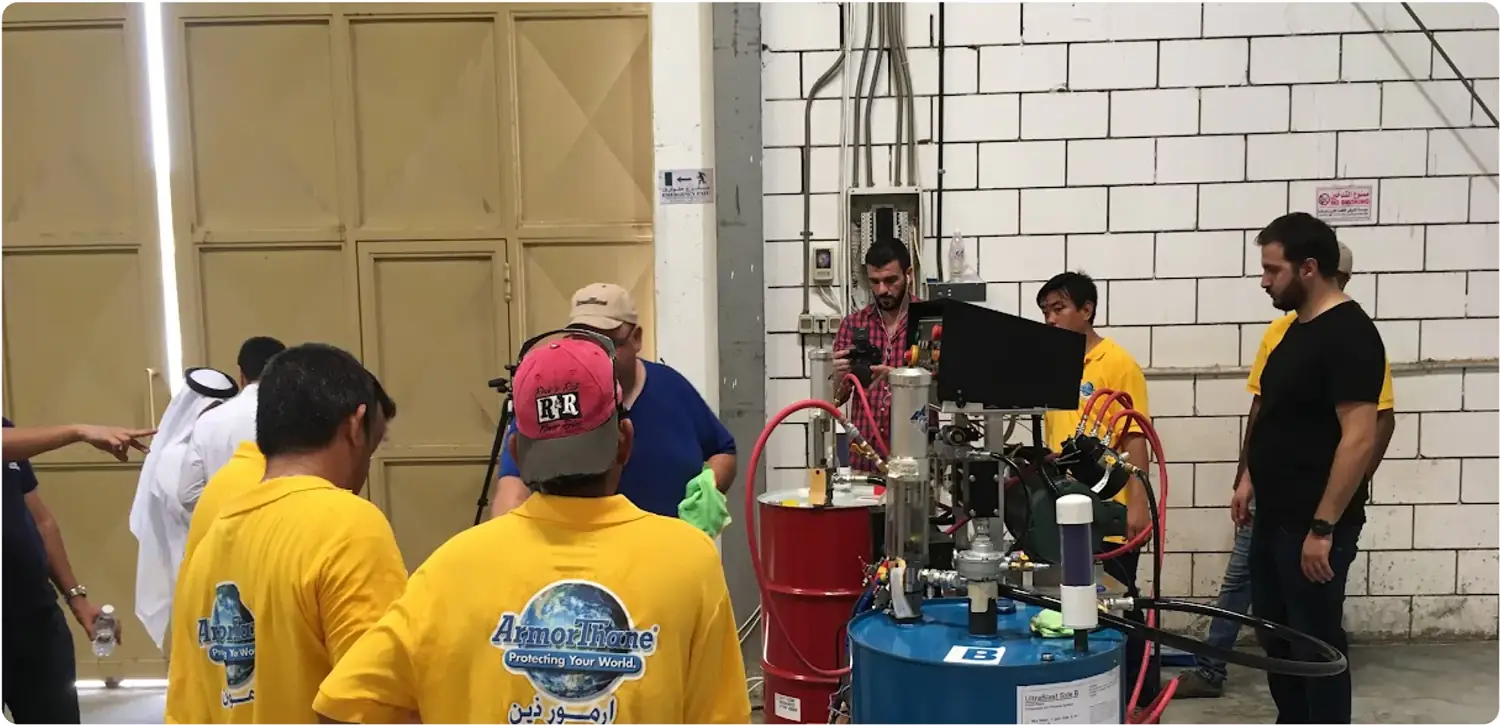
Equipment guide · Calculator
How much does spray-on bedliner equipment cost?
Published prices for low-pressure packages, high-pressure proportioners and full trailer rigs, plus the gear each one leaves out of the box.
Read the guide